
The Future of Low-Carbon Heating in Commercial Buildings
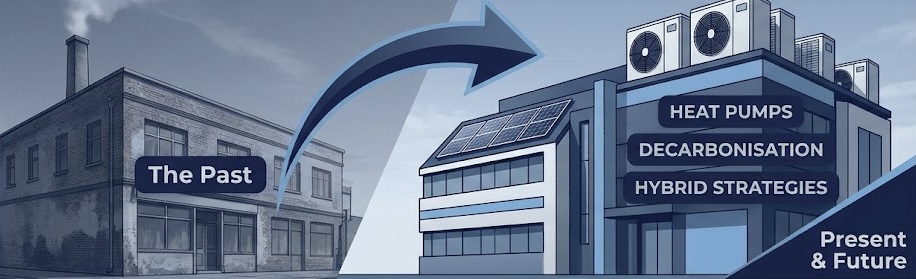
The path to decarbonisation is no longer a corporate social responsibility goal, it is a critical operational priority across many sectors, including healthcare, education, and commercial. Estates managers, consultants and developers all face mounting pressure to transition away from fossil fuels. With strict net-zero targets rapidly approaching, engineering leaders are moving from traditional combustion setups to alternative low-carbon infrastructure. However, the primary challenge for public and private sector clients remains unchanged: how do you decarbonise a building’s thermal footprint without compromising on peak heating performance, system reliability, or financial viability?
Heat Pumps Versus Traditional Gas Systems
There are various benefits to installing heat pumps:
1. Longer Lifespan: Traditional commercial gas boilers typically require replacement after 10 to 15 years. High-quality, modern heat pump installations easily last 20 to 25 years when properly maintained.
2. Lower Maintenance Requirements: Gas installations operate using combustion, this means they have burner elements, flues, and complex moving parts that suffer from soot and wear. Heat pumps are closed-loop systems with fewer internal mechanical components, requiring significantly less intense recurring maintenance.
3. Dual Heating and Cooling: Gas boilers can only provide thermal heating and domestic hot water. Many commercial air-source heat pumps are completely reversible, allowing the exact same system to deliver low-carbon heating in the winter and energy-efficient cooling during summer heatwaves.
4. No On-site Carbon Monoxide Risks: Because heat pumps rely purely on electrified heat transfer rather than burning fuel, they eliminate the need for gas safety infrastructure. This completely removes the threat of carbon monoxide leaks or combustion hazards within your facility plant rooms.
5. Energy Independence and Security: Moving away from gas cuts your organisation’s exposure to volatile global fossil fuel market price spikes. Pairing heat pumps with on-site solar panels or off-peak electricity tariffs delivers highly predictable long-term utility costs.
Hybrid Heating Strategies for Refurbishment Projects
While complete electrification using heat pumps is the goal for new builds, older estates and refurbishment projects present unique structural challenges. For a sprawling hospital wing, a historic university campus, or a multi-storey office block, full electrification can run into three major barriers:
- Electrical Grid Capacity: Upgrading a facility’s power supply to handle a massive central heat pump array can require expensive, time-consuming substation upgrades.
- Thermal Distribution Limitations: Legacy buildings are often designed around high-temperature water loops fed into traditional radiators. Standard heat pumps operate most efficiently at lower flow temperatures, which may necessitate replacing all existing emitters and pipework.
- Space and Continuity: Finding plant space for large thermal storage vessels can be a spatial puzzle, and commercial operations cannot afford extended downtime during system overhauls.
The Solution: Hybrid Decarbonisation
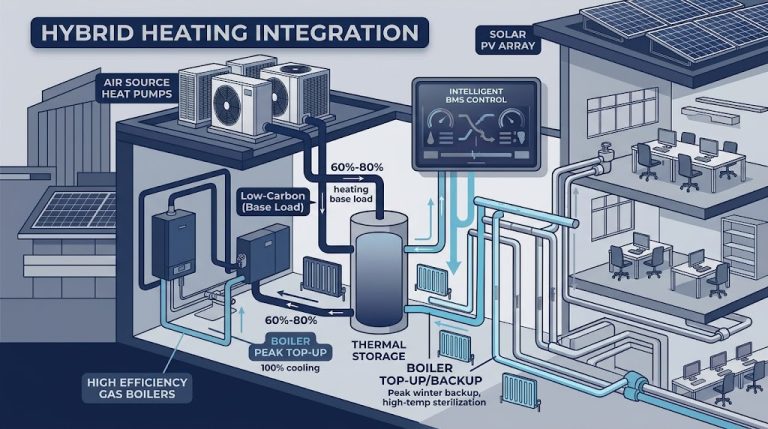
To bypass these barriers, consultants and estates managers are increasingly turning to hybrid heating strategies as an introductory pathway toward net-zero. A hybrid setup integrates low-carbon heat pumps alongside existing or high-efficiency gas boilers. The system is orchestrated by intelligent BMS Controls that calculate weather compensation, fuel utility pricing, and grid carbon intensity in real time:
- The Base Load (Heat Pumps): When outdoor temperatures are moderate, the heat pump runs continuously to handle 60% to 80% of the building’s seasonal heating and domestic hot water base load.
- The Peak Load (Gas Boilers): During sub-zero winters or periods of sudden, extreme hot water demand, the gas boilers fire up strictly to “top up” the system or supply the peak temperatures required by legacy infrastructure.
This approach avoids costly electrical grid upgrades while immediately stripping out most of the building’s annual carbon emissions.
Meeting net-zero targets without compromising performance
A common anxiety amongst clients and developers is that moving away from gas means sacrificing thermal reliability. In environments like acute care hospitals or schools, heating failure is not an option. Ensuring continuity requires a rigorous engineering approach:
- Advanced Fabric-First Methodology: Before sizing a new low-carbon heating plant, the building must be optimised. Improving insulation, upgrading glazing, and addressing air infiltration lowers the building’s overall peak heat loss. This allows engineers to specify smaller, less expensive heat pump units that can comfortably support indoor comfort levels even during extreme weather events.
- Smart Ventilation/Ductwork Installations: True net-zero success relies on a cohesive indoor climate strategy. Heat pumps should not work in isolation; they must be fully integrated with a building’s Ventilation and Ductwork Installations. Utilising heat recovery ventilation ensures that thermal energy from stale, exhausted indoor air is captured and recycled, significantly dropping the overall load on the central heating plant
Lessons Learned from Real-World Installations
Years of deploying low-carbon systems into commercial spaces have yielded several critical takeaways:
1. Sizing is Critical: Unlike gas boilers, which were historically oversized to provide a safety margin, heat pumps must be precisely sized. An oversized heat pump will short-cycle (turn on and off rapidly), which degrades the compressor, lowers operating efficiency, and spikes maintenance costs.
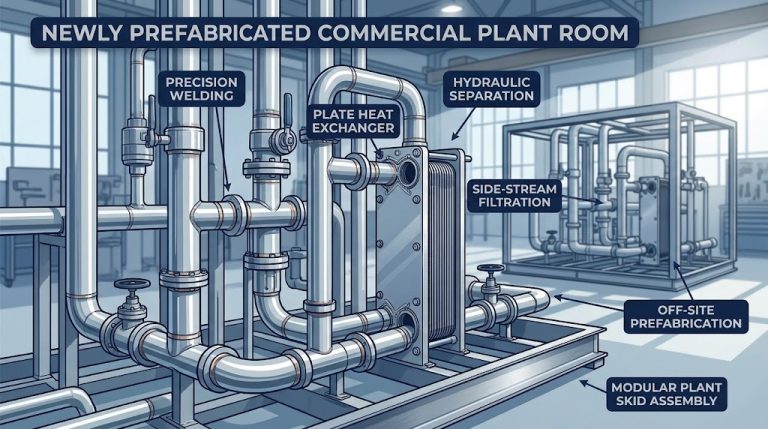
2. Hydraulic Separation and Water Quality: Heat pumps move high volumes of water at lower temperature differentials compared to gas boilers. Ensuring robust hydraulic separation via low-loss headers or plate heat exchangers, combined with side-stream filtration, is essential to protect the internal heat exchangers from fouling. This demands precision plumbing and pipe welding on-site to ensure leak-free, high-durability performance.
3. Minimising Site Disruption: Commercial and public sectors cannot afford lengthy downtime. Utilising off-site prefabrication allows engineering teams to pre-build modular plant room skids in a controlled factory environment. This cuts down on-site installation schedules from weeks to days, keeping hospital wings or classrooms open.
4. Early Engagement Prevents Delays: For any major low-carbon transition, engaging with the local Distribution Network Operator (DNO) regarding electrical capacity must happen at the feasibility stage, not during detailed design. Identifying electrical bottlenecks early prevents costly project delays.
How MEIS Protect and Future-Proof Your Facility
Navigating the complexities of a low-carbon energy transition requires specialised engineering expertise. M&E Integrated Services Ltd (MEIS) are equipped to design, install, and optimise building systems that bridge the gap between compliance and peak performance. We help businesses keep up with the future of low-carbon heating through a targeted, high-impact suite of mechanical engineering services:
1. Commercial Heat Pump Installations: We engineer and deploy air-source and ground-source heat pump arrays meticulously sized to provide a reliable, low-carbon thermal foundation for your property portfolio.
2. Intelligent BMS Controls: We integrate advanced Building Management Systems that serve as the “brain” of your facility, dynamically shifting loads between low-carbon systems and secondary plant equipment to maximise energy efficiency.
3. Optimised Ventilation and Ductwork Installations: Our teams integrate heat recovery ventilation systems to capture thermal energy that would otherwise be lost, driving down overall heating demands.
4. Off-site Prefabrication Services: To shield your business operations from lengthy plant room closures, we prefabricate modular plant skids off-site, reducing live on-site disruption to a matter of days.
5. Modern Gas Installations: Where pure electrification isn’t viable due to grid or structural limitations, we deploy high-efficiency gas systems tailored perfectly to step in for complex hybrid setups.
The Path Forward
The future of commercial heating is undeniably electric, but the transition requires an adaptive, expertly engineered approach. Whether through a complete heat pump installation or an incremental hybrid retrofit, matching the right technology to the specific building archetype is the only way to deliver true environmental sustainability without compromising operational excellence.
Work with our M&E team to see how a tailored low-carbon heating strategy can future proof your commercial property. Visit our services page, contact our team online or call our office on +44 (0) 28 9099 0331 today.